Did you know that spider monkeys are among the most acrobatic primates in the world? With their long limbs and prehensile tails, these remarkable creatures are perfectly adapted for life high in the treetops of Central and South America. But what do they really look like? Understanding the physical features of spider monkeys not only satisfies our curiosity but also highlights their unique adaptations for survival in dense tropical forests. Their striking appearance, featuring a slender body, expressive face, and vibrant fur coloration, makes them a fascinating subject for both wildlife enthusiasts and casual readers alike. Join us as we explore the intriguing characteristics of spider monkeys, and discover why these agile primates are not only captivating but also vital to their ecosystems.
What Are the Distinctive Physical Features of Spider Monkeys?
Spider monkeys are truly a marvel of the animal kingdom, captivating observers with their unique adaptations that suit their arboreal lifestyle. These primates are characterized by their long, slender limbs and prehensile tails, which serve as a fifth limb, helping them navigate the treetops of their tropical forest habitats with remarkable agility. Adults typically sport a lean frame, which aids in their acrobatic movements as they swing from branch to branch in search of fruits, nuts, and leaves.
One of the most distinctive features of spider monkeys is their elongated limbs. Their arms are significantly longer than their legs, which not only enhances their climbing abilities but also allows for impressive swinging motions through the canopy. This adaptation is critical for avoiding ground predators and accessing food sources high above. Additionally, their prehensile tail, which can grasp and manipulate objects, provides further stability when navigating the branches, allowing them to balance while reaching for food or avoiding potential threats.
Fur coloration in spider monkeys is another aspect that adds to their distinctive appearance. They typically exhibit a range of colors from black to brown, often with lighter patches or markings depending on the species. For example, the black spider monkey is mostly covered in shiny black fur, while the brown spider monkey has a lighter, more chocolate tone, giving them a warm and inviting look that contrasts beautifully with their vibrant surroundings.
In terms of facial characteristics, spider monkeys have unique, expressive faces. Their eyes are often large and dark, a trait that enhances their vision in the dim light of the forest canopy. This adaptation allows them to spot both friends and foes from a distance. The shape of their mouth is slightly different from other monkeys, which aids in their diet of various fruits. Together, these features create a face that is not only striking but also functional, helping spider monkeys thrive in their environment.
Overall, the distinctive physical traits of spider monkeys are a perfect example of evolution at work, shaping these fascinating primates to fit their ecological niche in the treetops. Whether it’s their long limbs that allow them to swing gracefully through the forest or their unique fur and facial characteristics that make them memorable, spider monkeys embody the beauty and complexity of wildlife.
A Closer Look at Spider Monkey Body Structure
Spider monkeys are truly one of nature’s acrobats, expertly adapted for their life high in the treetops of Central and South American rainforests. Their incredible body structure is a masterpiece of evolutionary design, which allows them to thrive in a challenging arboreal environment. These monkeys are known for their elongated limbs, with arms that can span significantly longer than their legs. This anatomical feature isn’t just for show; it provides them with unparalleled strength and flexibility as they swing, climb, and leap from branch to branch in search of food.
One of the most remarkable aspects of spider monkey anatomy is their prehensile tail, often referred to as a “fifth limb.” Unlike many other monkey species, spider monkeys use this tail to grasp branches, providing extra support and balance while navigating their complex habitat. The tail is highly flexible and muscular, capable of wrapping around limbs and holding onto objects with great precision. This adaptation is essential not only for mobility but also for foraging, as it allows them to reach fruits and leaves that might otherwise be difficult to access.
In terms of overall body composition, spider monkeys have a lean physique that aids in their agility. Their slender bodies are covered in fur that ranges from golden-brown to jet black, depending on the species, with patterns that can help them camouflage against predators in the dappled light of the forest canopy. Large, expressive eyes enhance their vision, crucial for spotting potential threats or fellow monkeys within their troupe, and their flat faces contribute to an astonishing range of social and vocal expressions, essential for communication among the group.
The combination of these features creates a primate that is not only visually striking but also perfectly adapted to its environment. Spider monkeys’ specialized body structure reflects the pressures of their arboreal lifestyle, showcasing how anatomy can evolve to enhance survival in specific habitats. As you observe these fascinating creatures swinging through the trees, it’s awe-inspiring to see evolution at work, crafting such specialized adaptations that ensure their livelihood and place in the ecosystem.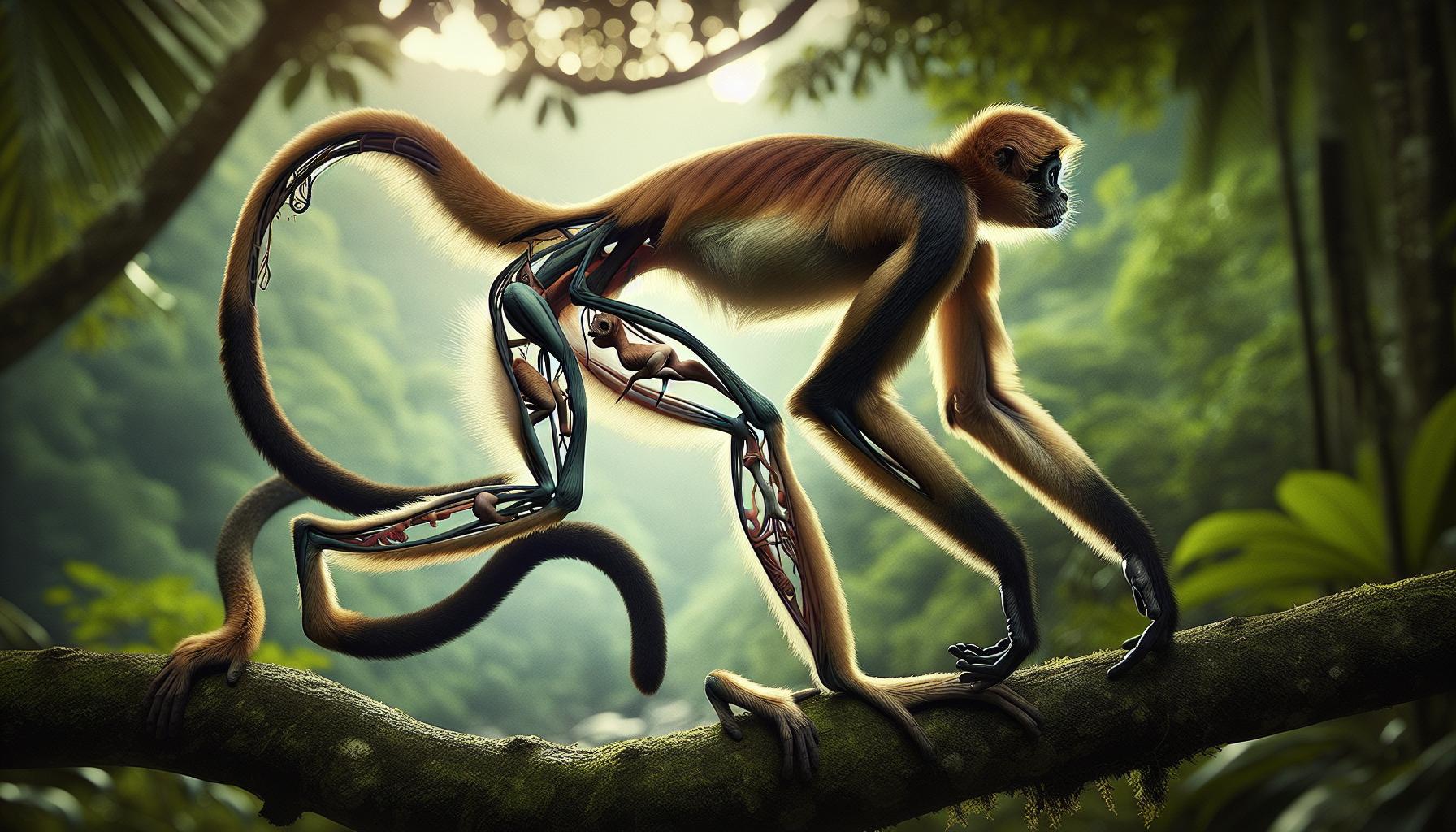
Is there Variation in Size and Weight Among Spider Monkeys?
Spider monkeys exhibit fascinating variation in size and weight that adds to their charm and adaptability. On average, these primates can weigh between 15 to 19 pounds (7 to 9 kg). However, some species, like the Black Spider Monkey, can tip the scales at a more substantial 22 pounds (10 kg). This range offers insights into their adaptability to diverse habitats and resources found across Central and South America.
Size Variation
The size of spider monkeys can vary notably among different species and even among individuals within the same species. For instance, the Northern Spider Monkey is generally smaller than its Southern counterpart. Adult males typically boast larger bodies compared to females, following a common pattern in many primate species. This size discrepancy often plays a crucial role in social dynamics and mating behaviors. In some groups, larger males might hold more dominant positions, influencing their access to mating opportunities and food resources.
Weight Factors
Weight in spider monkeys can fluctuate based on several factors, including diet, habitat, and individual health. Those living in environments rich in food sources-like fruits, nuts, and leaves-tend to weigh more compared to their counterparts in resource-scarce regions. Seasonal changes can also impact weight, as monkeys may gain pounds during fruiting seasons and lose some when food becomes scarce. Monitoring these weight variations provides valuable insights into their ecological health and the availability of resources in their habitats.
In summary, spider monkeys embody a blend of size and weight diversity that enhances their role in the canopy. Understanding this variation is not just about numbers; it’s about appreciating how these remarkable creatures have evolved to thrive in their lush, dynamic environments. As they swing gracefully from branch to branch, their agile yet powerful bodies reflect a rich history of adaptation and survival that continues to captivate wildlife enthusiasts everywhere.
Exploring Spider Monkey Fur and Color Patterns
Bright colors and unique patterns define the fur of spider monkeys, making them truly stand out among the forest canopy. These primates showcase a striking range of fur colors, from deep blacks and rich browns to hues of blonde and gray. The variations are not just for show; they serve a purpose in camouflage and social signaling within their lush habitats of Central and South America.
Spider monkey fur tends to be longer and coarser than that of many other primate species, making it ideal for their arboreal lifestyle. The dense coat helps insulate them from the elements while also providing some protection against the elements like sun and rain. Notably, the most recognized species, the Black Spider Monkey, has fur that can appear almost jet black, which aids in blending seamlessly into the shadows of the night. In contrast, the more colorful Red-faced Spider Monkey sports warm shades of red and orange, adding a vibrant splash to the green foliage of its environment.
These monkeys exhibit distinctive color patterns that can vary significantly among individual species. Some of these patterns can be influenced by their geographical locations, as different habitats foster varying color adaptations. For example, spider monkeys from drier, sunnier regions may have lighter fur, while those living in densely shaded rainforests tend to be darker, maximizing their camouflage among the shadows. Furthermore, these variations contribute to their social interactions; color can play a role in mate selection and can help to establish dominance within groups.
In addition to individual fur colors, spider monkeys often have lighter markings on their faces and limbs, adding to their unique appearance. The contrast between the lighter and darker fur enhances their expressive features, making them even more fascinating to observe. These adaptations showcase how spider monkeys have evolved not only to thrive in their specific habitats but also to maintain social structures that are crucial for their survival in the complex web of rainforest life.
Understanding Spider Monkey Facial Characteristics
Spider monkeys are not just acrobatic marvels of the treetops; their expressive faces tell a story of evolution and adaptation. One striking feature is their broad, flat noses, which enhance their sense of smell-an essential trait for foraging in the dense canopies of Central and South America. This nose structure is particularly prominent in species like the Black Spider Monkey, where it complements their overall dark and captivating facial characteristics. The face is often framed by long, flowing fur that can contrast sharply with the lighter patches typical around their eyes and mouths, helping these monkeys communicate their emotions and intentions within their social groups.
Their expressive eyes are another defining feature, often large and set wide apart, granting them a wide field of vision essential for spotting predators and navigating through their arboreal habitats. The coloration around their eyes varies: some species have striking light markings that enhance the expressive quality of their gaze, making their emotional state immediately noticeable to other monkeys. This is particularly important in their social structures, as spider monkeys are highly social creatures that rely on complex interactions and relationships within their troops.
Speaking of relationships, facial expressions in spider monkeys are vital for communication. They possess a range of facial movements that convey various emotions-from the playful curiosity of young monkeys to the stern expressions of a dominant adult. This ability to express feelings through facial cues helps maintain social bonds and hierarchies within their groups. For example, a relaxed, open facial expression can welcome kin, while a more rigid face might signal distress or readiness to defend territory. Their social nature means that understanding these facial features is crucial for both their survival and the preservation of their social dynamics.
Importantly, the unique characteristics of spider monkey faces are more than just aesthetic; they play a vital role in their adaptation to life in the trees. The combination of their facial structure, expressive eyes, and communication abilities enables them to thrive in complex social environments and navigate their lush habitats effectively. By maintaining eye contact or displaying certain expressions, spider monkeys engage in social bonding and coordination, essential for foraging and protecting one another in the dense forests they call home.
How Do Spider Monkeys Use Their Long Limbs?
With their long, slender limbs, spider monkeys are true acrobats of the rainforest canopy. These remarkable adaptations enable them to navigate through treetops with astonishing ease and agility, allowing them to thrive in their tropical habitats. Their limbs, which are disproportionately long compared to their bodies, can reach out to grasp branches, swing between trees, and perform impressive leaps that showcase their remarkable strength and coordination.
Agility and Movement
The elongated limbs of spider monkeys serve multiple functions. Primarily, they aid in brachiation, a form of locomotion in which they swing from branch to branch. This method not only conserves energy but also allows them to cover large distances quickly while searching for food or evading predators. Spider monkeys are known to swing nearly effortlessly between the branches, often using all four limbs for balance and support as they navigate the dense foliage. In tandem with their prehensile tails, which act like a fifth limb, they can maneuver skillfully in three-dimensional space, grabbing onto branches while reaching for fruit or leaves with their hands.
Foraging and Feeding
When foraging for food, their lengthy arms allow them to reach out to high-hanging fruits and leaves that many other animals cannot access. This gives spider monkeys a tremendous advantage in their dietary habits, as they primarily feed on fruits, nuts, and flowers found high up in the canopy. Their long limbs and flexible shoulders enable them to stretch and twist their bodies to access hard-to-reach food sources, showcasing an impressive combination of strength and flexibility.
Social Interactions and Grooming
Spider monkeys’ limbs also play a crucial role in their social lives. They often engage in grooming behavior, which helps strengthen social bonds among members of their troop. Using their long arms, they can easily reach around each other to clean hard-to-reach areas, a behavior essential for social cohesion. Such interactions are vital for maintaining the intricate hierarchies and relationships within a group.
Conclusion
In summary, the long limbs of spider monkeys are more than just a physical trait; they are an essential adaptation that supports their arboreal lifestyle, social interactions, and dietary needs. Their remarkable agility and strength allow them to navigate their complex forest environment, demonstrating the incredible ways in which nature equips animals to thrive in their habitats. This unparalleled adaptation truly makes spider monkeys fascinating subjects of study for wildlife enthusiasts and researchers alike.
The Role of the Spider Monkey’s Prehensile Tail
Spider monkeys possess a remarkable adaptation in the form of their prehensile tails, which function not only as an extension of their bodies but also as a vital tool for their survival in the dense rainforest canopy. This unique trait allows them to interact with their environment in ways that enhance their agility and foraging capabilities. The tail can grasp onto branches, effectively acting like a fifth limb, which provides both support and balance as they traverse the treetops. Imagine a gymnast using a balance beam-this tail ensures spider monkeys can effortlessly swing and maneuver around their arboreal habitat.
The prehensile tail is not simply a passive tool; it is highly muscular and sensitive, giving spider monkeys the ability to grapple with branches while simultaneously using their strong limbs to reach for food. When lunch is high up-a tantalizing cluster of fruit or a nest of leaves-these monkeys use their tails to stabilize themselves, allowing their hands to stretch further and grasp the elusive greenery. This adaptability means they can access food that other animals struggling with less dexterous appendages cannot reach, thus giving them a critical advantage in their fruit-based diet.
Additionally, this remarkable feature plays an essential role in social interactions among spider monkeys. During grooming sessions-an important activity for maintaining social bonds-individuals can wrap their tails around branches or even around their companions to stabilize themselves while they reach to clean those hard-to-reach spots. Such behaviors underscore the complexity of their social structures and highlight how physical features are intricately linked to social dynamics.
In summary, the prehensile tail of spider monkeys exemplifies nature’s exquisite design, enhancing their abilities to forage and stay connected within their social groups. This fascinating adaptation reflects their evolutionary journey, showcasing how specific physical traits can significantly impact an animal’s lifestyle and success in a challenging environment. Through understanding these features, we gain a deeper appreciation for the spider monkey’s role in the ecosystem and the delicate balance of life in the rainforest canopy.
Spider Monkey Eyes: Vision Adaptations in the Canopy
Spider monkeys are truly remarkable when it comes to their vision, a key adaptation that supports their life in the towering canopies of the rainforest. These primates have large, forward-facing eyes that provide excellent depth perception, allowing them to navigate the complex three-dimensional environment of the treetops with impressive agility. This ability is crucial, as they spend most of their lives swinging and leaping between branches in search of fruit, leaves, and flowers.
One fascinating aspect of spider monkey eyes is their ability to adapt to various light conditions. In the dappled sunlight of the forest, their eyes can adjust rapidly to differentiate between the bright spots and shadowed areas, which is essential for spotting food and avoiding predators. Their vision is particularly tuned for detecting movement, enabling them to keep an eye out for both the fluttering of leaves that might signal the presence of danger and the ripe fruits swaying enticingly in the breeze.
Furthermore, spider monkeys possess a unique visual acuity that enhances their foraging strategies. With exceptional color vision, they can distinguish between the subtle variations in colors of ripe and unripe fruits, which is vital for their fruit-based diet. This capability allows them to select the most nutritious food sources efficiently, ensuring they meet their dietary needs.
In the grand scheme of spider monkey behavior, their evolved eyesight supports much more than just feeding. It enhances their social interactions too. Spider monkeys are known for intricate social bonds and communication behaviors, and keen eyesight helps them read the facial expressions and body language of their companions. This connection fosters stronger social ties and plays an important role in their cohesive group structure.
In summary, the visual adaptations of spider monkeys are a testament to their remarkable evolutionary journey, showcasing how their physical features profoundly shape their lifestyle and survival in the intricate web of rainforest life. Their eyes not only provide the capability to thrive in their arboreal habitat but also facilitate complex social interactions that are key to their success as a species.
Understanding Vocalizations: What Spider Monkeys Communicate
Spider monkeys are known for their captivating social behaviors, and their vocalizations are a fascinating window into their complex lives. These lively primates possess a unique range of sounds that serve various purposes within their tight-knit communities. From alarm calls that warn of potential predators to the playful hoots and whinnies that signify social interactions, their vocalizations play a crucial role in maintaining group cohesion and communication in the dense canopy of their rainforest homes.
One of the most remarkable aspects of spider monkey vocalizations is their ability to communicate over long distances through loud, resonant calls. This trait is particularly advantageous in the thick foliage of tropical forests, where visibility can be limited. Groups often use specific vocal sounds to convey messages, such as alerting each other to danger or coordinating movements when foraging for food. For instance, a sharp, high-pitched call can indicate the presence of a snake or another threat, prompting a swift response from the group.
Additionally, the vocal repertoire of spider monkeys is not just about alarm signals; it’s equally about nurturing social bonds. When they are foraging or resting together, spider monkeys engage in a variety of sounds, including soft grunts and coos, which help reinforce their connections. These softer sounds can be interpreted as signs of affection or comfort, similar to how humans might share a laugh or a gentle word. This ability to express emotions through vocalization enhances their social structure and deepens their relationships within the troop, fostering a sense of community and cooperation.
In summary, vocalizations among spider monkeys are a multifaceted means of communication that encompasses warnings, social bonding, and group dynamics. By understanding their vocal behaviors, we gain insight into the instincts and social lives of these fascinating creatures, showcasing their intelligence and adaptability in the wild. Their calls not only aid in survival but also reflect the rich social tapestry of their lives, making them one of the most intriguing monkey species to observe and study.
Comparing Spider Monkeys to Other Monkey Species
In the diverse realm of primates, spider monkeys stand out not just for their striking appearance but also for how their physical features compare to other monkey species. Unlike many monkeys, spider monkeys lack a thumb, which sets them apart and contributes to their distinct locomotion in the trees. This anatomical difference gives them a unique adaptation that enhances their ability to swing effortlessly from branch to branch in their rainforest habitats. Their elongated limbs and prehensile tails, which can grasp and hold onto branches, allow them to navigate the treetops with remarkable agility, making them experts in arboreal living.
When defining their features, spider monkeys often get compared to howler monkeys, another member of the New World monkey family. For instance, while howler monkeys are known for their loud vocalizations-an adaptation linked to their larger throat structure-spider monkeys have more slender bodies, which contribute to their incredibly flexible movement. Each species has developed its own set of adaptations based on their ecological niches. Additionally, while howler monkeys may display fur colors that range from brown to black, spider monkeys often exhibit a more varied palette, including blonde, red, or even all-black fur depending on the specific species.
The differences become even more pronounced when contrasting spider monkeys with capuchin monkeys. Capuchins possess a more compact build and exhibit notable facial features, such as expressive facial expressions and the ability to use tools, thanks to their opposable thumbs. In contrast, the heavily muscled build of spider monkeys facilitates their specialized swinging behavior, showcasing a stark difference in how these monkeys interact with their environment. Their physical features reflect their evolutionary paths, resulting in diverse adaptations that highlight the incredible variety within the primate family.
In understanding these differences, it becomes clear that the spider monkey’s unique adaptations are not just fascinating but also essential for their survival. Their distinctive long limbs and prehensile tails serve as critical tools for navigating the complex three-dimensional environment of the rainforest, setting them apart in both physicality and behavior among their primate cousins. Each species of monkey, including the spider monkey, showcases the beauty of evolution, illustrating how different environments foster remarkable variations in appearance and capabilities.
Habitat and Its Influence on Physical Traits
In the lush canopies of Central and South America, spider monkeys have evolved remarkable traits that directly reflect their arboreal habitats. These primates are primarily found in tropical rainforests, where their unique adaptations allow them to thrive among the treetops. One of their most striking features is their long limbs, which are perfectly suited for swinging between branches. This elongated structure is not just for locomotion; it maximizes their ability to reach for fruits, leaves, and flowers-their primary food sources.
The physical features of spider monkeys, including a lack of a thumb, contribute to their specialized movement. This anatomical absence means they grasp branches differently, relying more on their long fingers and prehensile tails. Their tails are particularly impressive, acting almost like an extra limb. This prehensile characteristic enables them to secure themselves as they maneuver through the dense foliage, allowing for greater freedom of movement and reducing the energy expenditure often required in other primate species.
Their fur coloration, which can range from light blonde to deep black, also showcases an adaptive response to their environment. In the dappled light of the rainforest, these color variations help them blend in with the surrounding flora, offering camouflaged protection against predators. Moreover, this diversity in fur color serves the important role of social communication within their troops, as certain colors may signal age, health, or status to other spider monkeys.
Spider monkeys not only adapt physically to their habitat but also exhibit behaviors influenced by their surroundings. Living in large social groups, their vocalizations can be strategic, allowing them to maintain contact with one another across the vast expanses of the forest. These social interactions, combined with their physical adaptations, highlight the deep connection between habitat and the unique traits that define spider monkeys, ensuring their survival and continued evolution in the vibrant ecosystems of their rainforest homes.
The Importance of Adaptation in Spider Monkey Evolution
In the vibrant green canopies of Central and South America, spider monkeys demonstrate a fascinating array of adaptations that signify their evolutionary success. These adaptations are specifically designed to enhance their survival in an arboreal environment, highlighting the deep relationship between their physical traits and the demands of their forest habitat. The evolution of these unique characteristics, such as their long limbs and prehensile tails, is akin to nature’s way of fine-tuning a masterful performance on the stage of the jungle.
One of the most striking adaptations is their elongated limbs, which allow for efficient movement through the trees-essential for a species that relies on fruits and leaves scattered at varying heights. As spider monkeys swing from branch to branch, their arms not only provide propulsion but also help in balancing as they navigate the often precarious arboreal pathways. This design is not random; it’s a direct result of millennia spent adapting to life high above the ground, where agility and reach are paramount.
Another remarkable feature is their prehensile tail. Acting almost like a fifth limb, the tail is equipped with an exceptional grasping ability that provides spider monkeys with the extra security and flexibility needed to hold on to branches while they forage for food. This adaptation significantly lessens the risk of falling, which is vital not just for individual survival but also for maintaining the social structures inherent within their troops. Their ability to manipulate their environment with such dexterity is an evolutionary achievement that ensures they thrive amidst the challenges of predation and food scarcity.
Additionally, the variation in fur color among spider monkeys, which ranges from sandy yellow to deep black, provides camouflage that helps them blend into the mottled shadows of the forest. This not only aids in evading predators but also plays a role in social signaling, allowing individuals to communicate their health and status to peers. Such subtle adaptations enhance their survival while reflecting the interconnectedness of their physical traits with their ecological niche.
Ultimately, the evolution of spider monkeys embodies a perfect blend of form and function, showcasing how species can adapt remarkably to their environments. By studying these adaptations, we gain deeper insights into their interactions within the ecosystem and their role in the biodiversity of the regions they inhabit. Understanding these unique features fosters appreciation for the delicate balance of life in tropical forests and underscores the importance of conservation efforts to protect these remarkable animals and their habitats.
Faq
Q: What are the key characteristics of a spider monkey’s appearance?
A: Spider monkeys are characterized by their long, slender limbs, a prehensile tail that acts almost like a fifth limb, and typically, a small face with large eyes. Their fur varies in color from brown to black, which helps them blend into their forest habitat.
Q: How does a spider monkey’s tail differ from other monkeys?
A: The prehensile tail of a spider monkey is highly adapted for gripping, allowing them to swing through trees with ease. Unlike many other monkeys, their tail is hairless on the underside, providing a secure grip on branches while foraging or moving.
Q: Are spider monkeys large or small compared to other monkeys?
A: Spider monkeys are considered medium to large-sized primates. Adult males can weigh between 18 to 28 pounds, while females are usually smaller, weighing around 15 to 24 pounds, making them larger than some other New World monkeys but smaller than apes.
Q: What colors can spider monkey fur be?
A: Spider monkey fur can range in color, including shades of black, brown, and yellowish tones. These variations help them blend into the tree canopy, enhancing their camouflage against predators.
Q: How do spider monkeys’ physical features support their arboreal lifestyle?
A: Their long limbs and flexible joints are crucial for their arboreal lifestyle, allowing quick movement and agility in trees. The prehensile tail aids in stability and grasping, enabling spider monkeys to navigate their complex forest environment effectively.
Q: Do spider monkeys have any distinctive facial features?
A: Yes, spider monkeys have small, flat noses and wide-set eyes. Their facial features contribute to their unique appearance, with expressions that enhance social interactions within their groups.
Q: What adaptations do spider monkeys have for vision?
A: Spider monkeys possess large, forward-facing eyes that provide excellent depth perception and visibility in their canopy habitat. This adaptation is essential for spotting food and potential threats while moving among the branches.
Q: How does the size of a spider monkey’s body impact its lifestyle?
A: The size and body structure of spider monkeys allow them to be efficient tree dwellers, as their long limbs help grasp branches, while their lighter body makes it easier to swing and travel swiftly through their forest environment.
To Wrap It Up
Now that you’ve explored the fascinating physical features of spider monkeys, imagine the vibrant world they inhabit! These unique primates not only captivate with their long limbs and expressive tails but also play vital roles in their ecosystems. If you’re eager to learn more about their behavior and habitat, check out our articles on “Spider Monkey Conservation Efforts” and “The Social Structure of Spider Monkeys.”
Don’t miss out on the chance to dive deeper into the animal kingdom! Subscribe to our newsletter for the latest updates and exciting insights into wildlife. Whether you’re a wildlife enthusiast or just curious, there’s always more to discover. Share your thoughts in the comments below, and let’s keep the conversation going! Your adventure into the world of spider monkeys is just beginning-explore more today!
Get our latest guides, news, and insights highlighted in your Google Search & AI Overviews.